Every Raise Has a Second Number. The Government Publishes It.
The percentage your manager gives you is only half the subtraction.
“Did I get a raise?”
Your manager will say yes this quarter and give you a percentage. The percentage will be true. Whether it is a raise is a second calculation, and the government publishes the other half of it.
Every Sunday I look at the senior analytics market for the one thing worth doing before the next one. This week it is a subtraction. On October 22, Indeed Hiring Lab reported that posted wages grew 2.4% year over year in September 2026, while consumer prices rose 3.7% over the same twelve months. Postings are growing again. The pay printed on them is not keeping up.
What’s actually moving in the market
Indeed Hiring Lab, U.S. Labor Market Snapshot, October 22. The Job Postings Index read 103.8 on October 16, up 0.3% from the month before and up 2.8% from a year earlier, against a year-over-year reading of negative 8.1% in October 2025. Posted wage growth was 2.4% in September, “cooling slightly after a string of stronger summer readings.” Hiring Lab titled its own chart “Gap between inflation and wage growth widens,” and reported that inflation-adjusted average weekly earnings fell 0.5% from August to September. The market is hiring more and, in real terms, paying less.
BLS, Consumer Price Index, September 2026, released October 14. All items rose 3.7% over twelve months, not seasonally adjusted. That is the price half of the subtraction. Posted wages minus prices is about negative 1.3 points. The arithmetic is mine, and it is rounded.
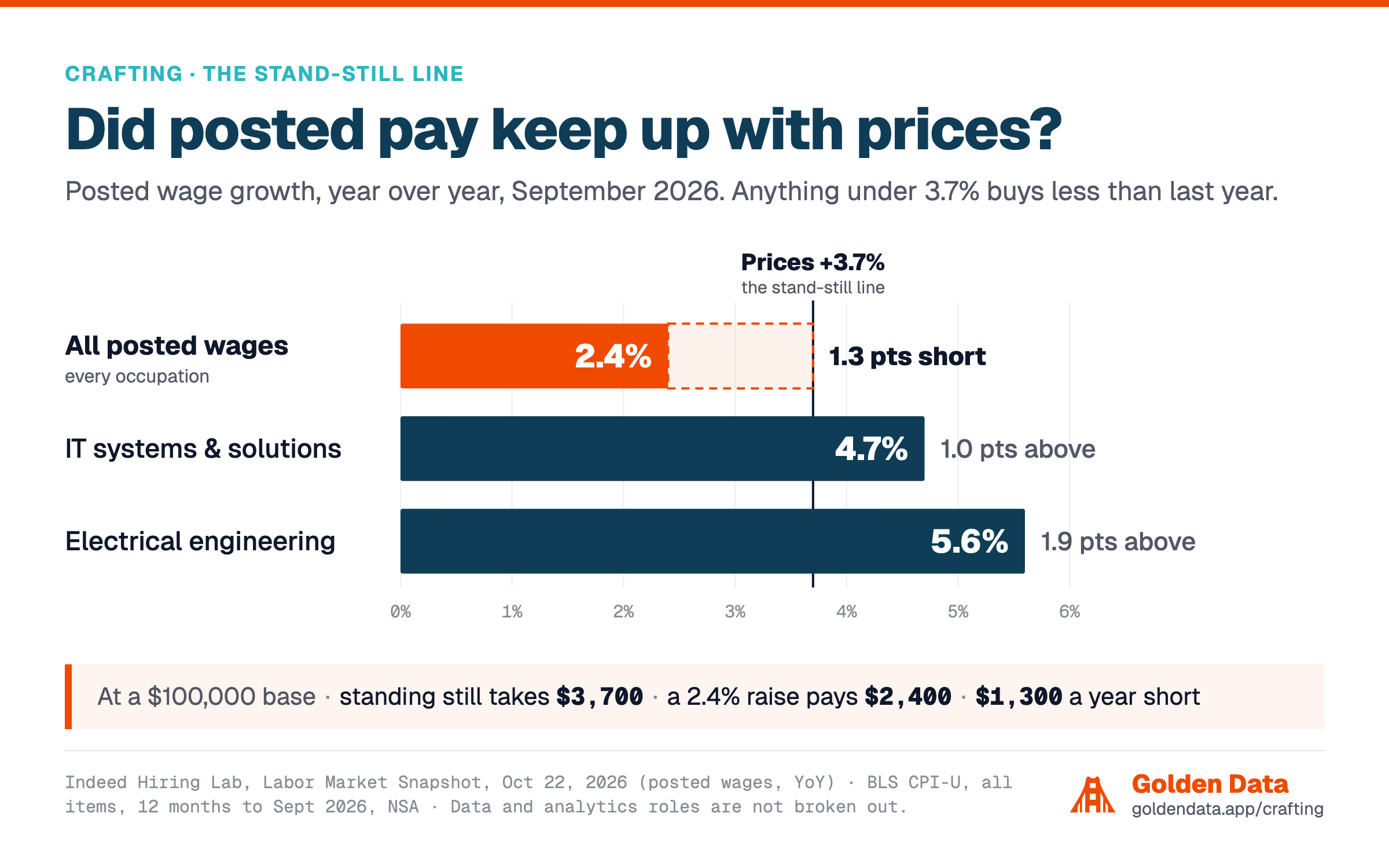
The neighbors are not equal. The same snapshot puts posted wage growth for IT systems and solutions at 4.7% and for electrical engineering at 5.6%. Both sit above 3.7%. Hiring Lab does not break out data and analytics, so I cannot tell you which side of the line analytics sits on. Software development, the nearest chart it does show, has the lowest postings index of the sectors it plots, around 79 by my reading of the infographic. Read the gap as a spread across fields. It is not one number applied to everyone.
What my own tracker can and cannot say. My JD Salary Tracker digest, dated October 26, lists Affirm’s Analytics Lead, Full Stack at $185K to $245K, DoorDash’s Manager, Analytics, Customer Experience at $184.3K to $271K, and Best Buy’s Director, Customer Insights at $133K to $237K. Those are posted base bands. The digest carries one date, so it cannot tell me what those bands were a year ago. I will not claim they shrank.
The counter-read: posted wages are what new ads print, not what incumbents are paid, and a senior hire can land above the advertised growth rate. The series covers all occupations. CPI is a national average, and your rent may not be. One month’s reading is a reading. Indeed itself called it a cooling from a hotter summer. All of that is fair. None of it changes what happens to a raise that is smaller than the price level. The market-wide gap is the headline. Your gap is your own raise minus your own prices, and that one you can compute.
Here is the unit. The stand-still raise is the raise that leaves your purchasing power where it was. At a $100,000 base, 3.7% is $3,700. A 2.4% raise is $2,400. The gap is $1,300 a year, every year it compounds. On October 11 I wrote that the title is a step and the band is a plateau, which was about where you land in a band (Crafting #25 - The Title Is a Step. The Band Is a Plateau). This is about what the band is worth once you are in it.
What I’d do this week
Two moves. Both fit between meetings.
Deflate your own pay history.
User moment: Sunday evening, before your next review cycle or the next call where someone asks what you are looking for.
Shape: One row per pay change in the last three years: the effective month, your base, and the all-items CPI-U index for that month from BLS (series CUUR0000SA0). Restate each base in September 2026 dollars: your base times the September 2026 index, divided by that month’s index. It is the same restatement I would run on any dollar series in BigQuery. Divide by the index. Multiply by the base month.
Time budget: Forty minutes. One sheet.
Artifact: A table whose last column is the real change since each date, and one sentence under it: “In today’s dollars my base is $X, against $Y three years ago.”
Success: You walk into the next comp conversation with a dollar figure, not a percentage. “My base is down $6,000 in today’s dollars” is a different sentence from “I’d like a raise.”
Credible failure: The table shows you ahead. A job switch or a promotion may have outrun prices. Then your problem is not the base. Spend the time on the next move, which is the equity and level conversation, and keep the table for the day that changes.
Convert the stand-still raise into the ask.
User moment: Your next scheduled 1:1, or the first recruiter call of the quarter.
Shape: Multiply your base by 1.037. Write the dollar difference. Then ask one question, word for word: “Is the merit budget for my level above or below the twelve-month inflation rate this cycle?”
Time budget: Ten minutes of prep.
Artifact: One number: your stand-still raise in dollars, written before the conversation.
Success: The answer comes back as a percentage and you can say, in dollars, whether it clears the line. The person who named the number first is negotiating from a figure. The person who waits is reacting to one.
Credible failure: The budget was set in the spring, before the latest print. Then you have learned the budget trails prices, and the next question is whether an off-cycle adjustment exists. Ask once. The pause is the answer.
I did both for one seat this week, a Director of Sales or Revenue Operations: six sources on what it pays, the raises that actually ran against the 3.7% line, and the dollar figure to write down before the next comp conversation. Two pages, in the download button under the byline. It is the sheet I post alongside this issue.
The 3% is the raise. The 3.7% is the stand-still. Below it, a raise is a cut with good manners.
Sources
-
Indeed Hiring Lab, U.S. Labor Market Snapshot, October 2026 — Indeed Hiring Lab, October 22, 2026 (Job Postings Index 103.8; posted wage growth 2.4%; sector wage growth; real weekly earnings)
-
BLS, Consumer Price Index Summary, September 2026 — Bureau of Labor Statistics, October 14, 2026 (all items +3.7% over twelve months, not seasonally adjusted)
-
JD Salary Tracker digest, October 26, 2026 — Golden Data (Affirm, DoorDash, Best Buy posted bands)
-
The Title Is a Step. The Band Is a Plateau. — Golden Data, Crafting #25, October 11, 2026
Crafting runs weekly. The job is to be useful, not to sell. If a line in here is close to a move you're working on, the email reaches a person.
Hiring rather than hunting? Signal is the column for your side of the desk.
← All Crafting issues · Drafted with Claude · Edited by Paul Brown